


A4A Feature and Capabilities Overview
Infrastructure is aging, requirements for critical structures are tightening, and seismic resilience matters more than ever. You need to know a structure’s load bearing capacity reserve and failure mechanism before you decide how to strengthen it.
1. Nonlinear concrete behavior from loading to limit state
2. From first load to limit state: nonlinear concrete modeling in ANSYS
Assess and Strengthen Existing Structures
A4A assesses the load capacity of existing reinforced concrete structures — bridges (including prestressed ones), high-rise buildings, dams, nuclear and industrial facilities. Results reveal the weakest points, show where to add reinforcement, and even simulate crack closing — A4A’s unique nonlinear capability

R&D for Reinforced Concrete Behavior
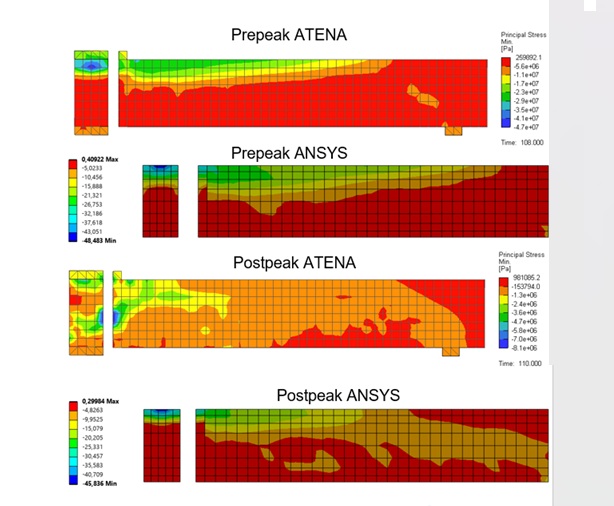
Develop new structural concepts and validate numerical models against full-scale experimental results — now directly in ANSYS. A4A relies on ATENA’s advanced nonlinear material model, already trusted by hundreds of universities and research institutions worldwide.

Beyond First Cracking
A4A models the full nonlinear behavior of reinforced concrete — cracking, crushing, reinforcement yielding — right up to the failure mechanism and load bearing capacity reserve determination. Instead of a single code-based safety check, you see exactly at what load level, and where, your structure would fail..
Seismic and Dynamic Response
Combined with the ANSYS structural solver, A4A enables nonlinear dynamic analysis of reinforced concrete structures — including the effects of human-induced and natural seismic activity. Its ability to simulate crack closing is key to capturing these effects realistically, and it’s unique among solutions on the market.
1. Fewer steps between model and answer
2. Comfort that saves time, not just results
One Environment, Native Integration
A4A combines the full power of ANSYS — nonlinear modeling, structural dynamics, contact modelling, Multiphysics, and Python or ACT automation — with ATENA’s specialized concrete material model, all in one environment. No need to switch between two separate programs.

Independent Concrete and Reinforcement FE-Mesh
With ANSYS, concrete and reinforcement can be meshed independently, removing the need for shared nodes and complex geometry partitioning. For large structures such as bridges, this means faster model setup, reduced preprocessing effort, and seamless scaling to detailed 3D FE models—making large projects significantly more efficient

Detailed Output and Crack Visualization
Watch cracks form and grow, concrete crush, and reinforcement yield — directly on your 3D model in ANSYS. Results are easy to interpret and document without leaving the ANSYS environment, down to 67 state variables from the ATENA material model, including crack width.
1. How A4A calculates — the technical detail, for those who want to know how
2. Under the hood: mesh, solvers, output variables
ANSYS solvers and enviroment support
Text nemáme

Closing of cracks, cycling loading
text nemáme

Adwanced models of shear crack
text nemáme

Frequently asked questions
These are the questions engineers and researchers ask most often before starting with A4A: how licensing works, which ANSYS and ATENA versions it supports, and what types of structures it’s built for. Answered directly, without sales language.
What is A4A?
A4A is a joint product by DESIGNTEC and Červenka Consulting, developed together to bring the ATENA concrete material model (CC3DNonLinCementitious2) directly into ANSYS.
It models crack formation and growth, concrete crushing, and reinforcement yielding — all within a single ANSYS environment, with no switching between two separate programs.
A4A builds on ATENA’s proven material modeling technology from Červenka Consulting, trusted in over 2500 installations worldwide.
How is A4A licensed?
A4A is an ANSYS extension requiring its own license — you don’t need an ATENA license, and it isn’t part of any ATENA license package. You just need your own A4A license and an ANSYS license, since the two work together.
A4A is available on an annual license, separate from any ATENA license. Pricing is set individually based on your needs — contact our team for a tailored offer.
If you’d like to try it first, we offer a free 30-day demo. If it delivers value, you can then request an annual paid license.
Which ANSYS environments and versions does A4A support?
A4A comes in two forms: an ANSYS ACT extension for ANSYS Workbench and Mechanical, and an ANSYS UPF material library for ANSYS Mechanical APDL, the classic interface. That means A4A also supports users working in APDL — not something you can take for granted, since many similar tools only cover Workbench.
The current version is tested and validated with ANSYS 2025 R1, and we’re expanding support for other ANSYS and ATENA versions over time — the latest supported version is always listed prominently on this page.
How does A4A model reinforced concrete behavior?
The CC3DNonLinCementitious2 material model captures the key nonlinear mechanisms behind reinforced concrete behavior — crack closing, concrete crushing, creep, rotated crack modeling, and tension stiffening in densely reinforced beams — for a realistic prediction of cracking, failure, and long-term performance. Further details are available on the ATENA product page.
On top of that, ANSYS meshes concrete (SOLID185/186/187) and reinforcement (REINF264/265) independently, linking them at the integration-point level instead of requiring shared nodes. This greatly simplifies model development and enables efficient simulation of large-scale structures such as bridges, dams, and nuclear facilities.
Why choose A4A over standard ANSYS concrete models or standalone ATENA?
ANSYS has been actively strengthening its own concrete modeling capabilities — recent developments such as the Dynardo acquisition and the MultiPlas material library integration clearly show that commitment, and we welcome this direction.
A4A takes it a step further, bringing ATENA’s CC3DNonLinCementitious2 model into ANSYS — one of the market’s leading solutions for nonlinear reinforced concrete analysis, with a proven track record for predicting failure mechanisms and load bearing capacity reserve.
Working in ANSYS also gives you the whole ecosystem beyond the material model itself, including SpaceClaim, which directly imports more than 40 standard CAD, CAE, ECAD, and mesh formats and significantly cuts the time needed to prepare a simulation-ready FE model.
Who is A4A for, and what types of structures can it analyze?
A4A is built mainly for universities and research institutions working on reinforced concrete, along with research organizations and engineering firms handling larger structures.
Typical uses include checking reinforcement design, assessing existing structures, and analyzing behavior beyond standard load scenarios to predict ultimate load capacity.
It works well across a wide range of structures: bridges (including prestressed ones), high-rise buildings, dams, nuclear power plant structures, underground structures, and large industrial and offshore facilities.
Who do I contact with questions or issues?
The DESIGNTEC team provides support for A4A. For questions about installation, licensing, or usage, reach us at support@designtec.eu or through the contact form below.
Licencing A4A
A4A is licensed separately as an annual subscription, independent of any ATENA license. To run A4A, you’ll also need your own ANSYS license, since the two integrate directly.
We calculate the license price individually, based on your organization and how you plan to use A4A.
Want to try it first? Get a free 30-day demo of A4A.
Contact & Support
Interested? Any more questions?
You talk directly to the developers of A4A.
Just send us an email support@designtec.eu or fill the form below.
Start your free trial today!

Your contact person
Petr Vymlátil
Managing Director
Designtec s.r.o.
+420 777 568 356
Designtec s.r.o.
Žižkova 59
617 00 Brno
Czech Republic